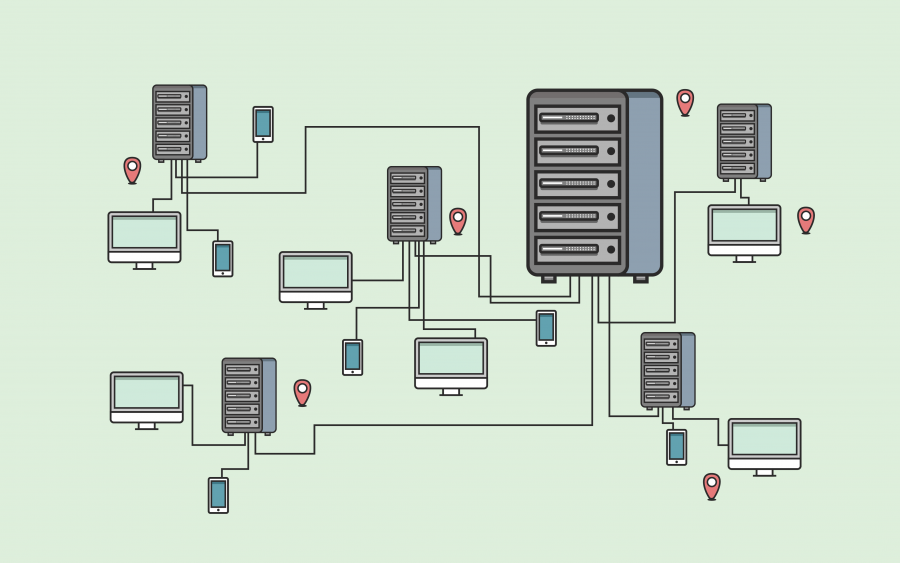
The term computer network refers to a group of electronic devices—often computers in one form or another—connected to each other via wires or wirelessly. The rules of communication between these devices are governed by protocols for transferring, storing, and accessing data. A network can be very small, such as a home computer connected to a printer, or extremely large and widespread, like the Internet.
Due to the immense scale computer networks can reach, they are classified into many types, each with a different purpose, use, characteristics, advantages, and disadvantages. Several network architectures have evolved to guide their design and implementation; these are frameworks created due to the complex nature of networks, where both the underlying technologies and the requirements of the software using them are constantly changing.
Types of Computer Networks
Below, we review the most prominent types of computer networks:
Personal Area Network (PAN)
Local Area Network (LAN)
Campus Area Network (CAN)
Metropolitan Area Network (MAN)
Wide Area Network (WAN)
Personal Area Network (PAN)
A Personal Area Network (PAN) is the smallest and least complex type of computer network. As the name suggests, it typically revolves around a single person, connecting their devices to each other or to an external network. These devices may be general-purpose computers—such as desktops or laptops—or other technical devices like printers, smart home appliances, Internet of Things (IoT) devices, or phones.
Key advantages of PANs:
They feature relatively good security and protection levels because the number of connected devices is limited, and the owner is usually the same person.
The geographical range of this network is very small, often not exceeding a few meters.
Disadvantages of PANs:
They lack the ability to spread over a medium to wide range. If a home is large or consists of multiple adjacent buildings or floors, a PAN may not be sufficient, and the user will need to establish a small LAN or add signal boosters, cables, and perhaps antennas for wireless transmission.
Network signals may interfere with other networks operating on the same frequency or band.
Local Area Network (LAN)
A Local Area Network (LAN) is the second type of computer network in terms of size. It spans relatively small areas, such as a single building, a floor within a building, or a home. It shares the resources within that building—such as printers, archived files, or hard drives—among the connected computers and devices.
Key advantages of LANs:
It is a private network that cannot be accessed by anyone from the outside.
It reduces the cost of resources allocated to each computer; resources like expensive software can be used over the network without purchasing a copy for every computer. Similarly, a single internet connection can be shared by all computers on the network.
Disadvantages of LANs:
The initial setup cost for LANs is high, even if it saves on operating costs later.
They require continuous management and monitoring to fix hardware and software issues.
A network administrator can access all files on the network computers; while the network is protected from external connections, users within the network may have limited privacy for files on their individual machines.
Campus Area Network (CAN)
The third type is the Campus Area Network (CAN), sometimes called a Corporate Area Network. It is typically used in university campuses, spanning academic buildings, libraries, and administrative offices. In a corporate context, it connects various company buildings. It is larger than a LAN but smaller than a WAN or MAN.
Key advantages of CANs:
They span a range between 1–5 km.
High data transfer speeds, as they use a mix of wired Ethernet and high-speed fiber optic cables.
High protection levels due to the sensitive nature of corporate or university data. Strict security measures are placed on network hardware via Firewalls and Proxy Servers, in addition to specific permission levels for each employee and physical security measures.
Disadvantages of CANs:
The number of allowed nodes (computers or other devices) is limited, and the network range is restricted by distance.
High maintenance and management costs compared to LANs or WANs.
Metropolitan Area Network (MAN)
A Metropolitan Area Network (MAN) spans a larger range, covering areas up to 50 or 100 kilometers. These are complex networks that may consist of several LANs connected together via fiber optic cables.
Key advantages of MANs:
High data transfer speeds compared to LANs; while LANs range from 1–100 Mbps, MANs range between 34–159 Mbps.
They use a dual-bus feature to transfer data in both directions of the transmission medium (like a cable) simultaneously.
Advanced technical support, as they are usually managed by large companies or government entities.
Disadvantages of MANs:
High construction and operation costs, requiring expensive infrastructure and specialized maintenance teams.
Difficulty in securing the network against hacker attacks due to its wide geographical distribution.
Wide Area Network (WAN)
A Wide Area Network (WAN) spans a much broader range than the previous types. It can be established between several buildings or grow to cover the entire world. The Internet—which connects billions of computers and devices across continents, under the sea, and even in space (as in the case of the International Space Station)—is the ultimate example of a WAN. Therefore, this type is the most flexible in terms of scaling.
Key advantages of WANs:
The ability to cover vast geographical areas, allowing company branches to be linked regardless of distance.
They include the same advantages as LANs, such as resource sharing and cost reduction.
Disadvantages of WANs:
Initial setup costs are extremely high as they may involve installing infrastructure over a large geographical scale.
Difficulty of maintenance for untrained hands; specialized network professionals must be hired.
Long duration required to repair faults, as technicians must inspect many parts of the network across different buildings and transmission media.
Other Types of Networks
There are more specialized types of computer networks that serve specific purposes:
Wireless Local Area Network (WLAN): These allow wireless connection for one or more devices within a limited range, using devices like wireless routers, Access Points, or Repeaters.
Storage-Area Network (SAN): A SAN consists of storage units (hard drives or full servers) dedicated to storage. It functions as a pool of storage accessible via a network of servers, providing high-speed data access.
Enterprise Private Network (EPN): Companies build these private networks to securely connect multiple locations, ensuring the safety of sensitive data without external access.
Virtual Private Network (VPN): A VPN is private in terms of privacy but uses a public network (the Internet) to connect to remote sites or users. It uses virtual connections routed through the Internet from the organization’s network to a third party, and then to the remote site.
Conclusion
In this article, we have explored the most common types of computer networks, their uses, and their pros and cons. We learned that they are classified based on their size and purpose. While other types exist, such as Home Area Networks (HAN), this overview provides a simple introduction to the most famous classifications.