Huawei did not falter much when the administration of President Donald Trump surprised it in 2019 with a trade ban and added its name to the blacklist, depriving it of all software products, hardware components, or those developed with American technologies. The U.S. restrictions led to Huawei's lack of the Android operating system from Google on its phones and the Windows operating system from Microsoft on its computers, but the Chinese company was ready with an alternative.
Just three months after that ban, Richard Yu, CEO of Huawei's Consumer Business Group, said that the company could switch its phones from using Android to its own system within a day or two at most, confirming the Chinese giant's readiness with the alternative for years, according to his August 2019 interview with CNBC.
"HarmonyOS," or HongmengOS as it is called in Chinese, is Huawei's winning card in the operating system market, through which the company expressed its ability to achieve software self-sufficiency to power various forms of smart devices, starting from sensors and micro-components inside electronics, through smartphones and smartwatches, to electric cars, televisions, and smart glasses. Huawei announced at its developers conference HDC 2023 last year that the number of devices running its HarmonyOS operating system exceeded the threshold of 900 million devices, ranging from phones, smartwatches, and personal computers to smart cars and massive data centers, over a decade since its launch.
How does the Huawei HarmonyOS work?
Huawei developed its operating system according to three main criteria. The first is the possibility of achieving integration between different Huawei devices at the operating system layer, as devices can be transformed by intersecting together into a super device that can merge the capabilities of different devices to meet the user's needs instantly, with the possibility of sharing the components and capabilities of those devices with each other, allowing the user to accomplish more across their devices regardless of which device they are using.
The second criterion depends on creating a rich environment for users by providing a smooth software environment that makes it easy for developers to write their application codes only once, and then they can be run on all Huawei devices, creating a consistent experience for the same application on the user's various devices.
As for the third criterion for developing the HarmonyOS operating system, it depends on the possibility of running the system on demand for devices with different capabilities, thanks to its component-based design, where HarmonyOS can adapt to different device forms based on their resource capabilities and service characteristics.
In order for Huawei to be able to bring its own operating system to the market quickly, it relied at the beginning of its development on the open-source code of the Android system, as well as on a software kernel based on the Linux system, in order to be able to attract Android users easily to its new phones with its own operating system, as a Huawei phone user with the HarmonyOS system could easily install their favorite Android applications on their phone by installing a file in Apk format, which is an abbreviation for Android Application Package.
Huawei launches NEXT update for HarmonyOS with "Standard Features"
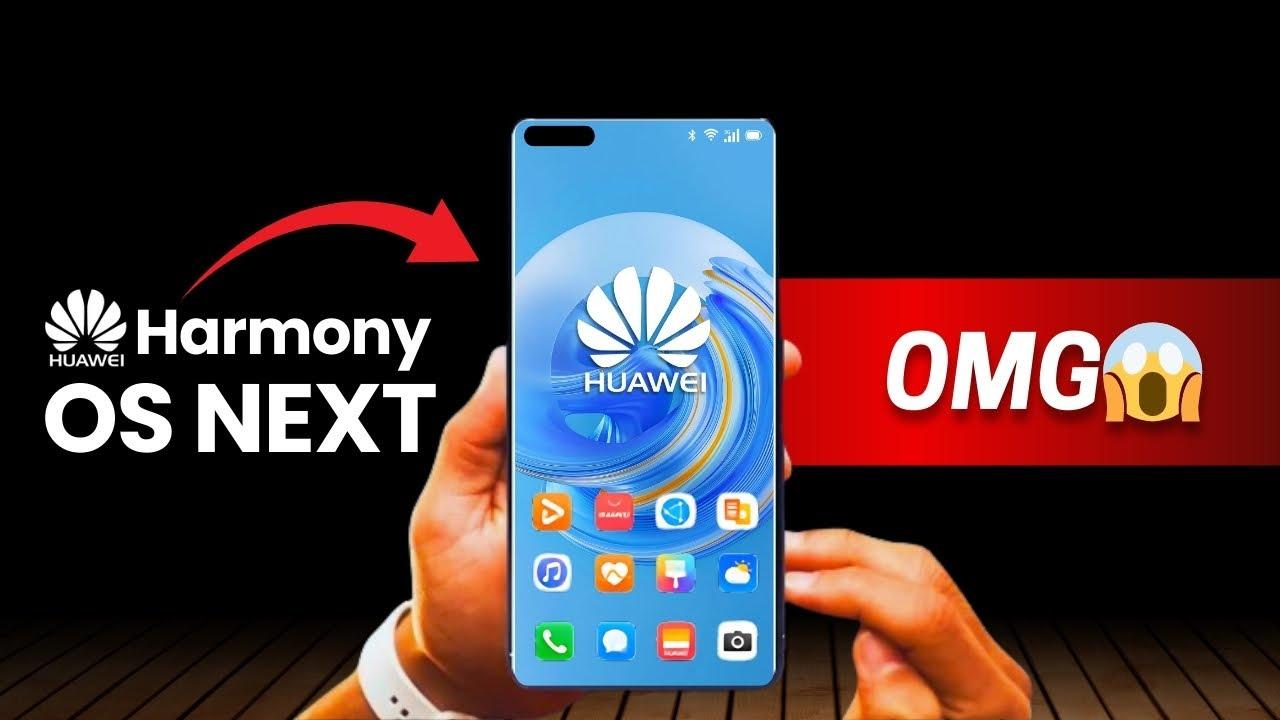
Learn about the features of the new version of the HarmonyOS operating system from Huawei for its smart devices, which comes equipped with artificial intelligence features in a step toward independence from Android. However, with the arrival of the new version of the Huawei device operating system, HarmonyOS NEXT, expected to arrive officially in October, the Chinese company is preparing to change its users' experience completely. They will not be able to install apk files for applications available on the internet, and their only outlet for obtaining applications will be the official Huawei store, reflecting a radical change in the architecture of the Huawei operating system.
The new system architecture depends on a better software kernel, which is three times more effective than Linux. It is also fully secured and allows for the possibility of using HarmonyOS NEXT on devices and applications that require a high degree of protection, such as running features and applications in data centers, smart cars, and others. The company succeeded in achieving and completing a technical development within 10 years, while European and American companies took nearly 30 years to achieve it, according to Yu's statements last June.
Features of the HarmonyOS NEXT system
Huawei is trying to provide a different experience for its device users with the HarmonyOS NEXT operating system to be able to compete with what Apple offers through its smart devices. With the new system, the Chinese company will offer a "Continuation" experience. Once two Huawei devices are brought close together, a message will appear on the screen of the other device, which the user can click to follow their experience on the new device. The two devices can be phones, tablets, computers, or even smart cars. Most importantly, both devices must be from Huawei and run its new operating system to enjoy the new feature.
The continuation experience is currently available through some applications, such as Amap, DingTalk, and WPS, where images or texts can be copied between two devices quickly and directly as soon as they are adjacent. Huawei focused in its new system on keeping pace with the development of the artificial intelligence market by providing its package of smart applications and services, Huawei Intelligence, in clear competition with Apple's personal artificial intelligence system, which carries the name Apple Intelligence.
The new features included the AIGC service, which allows the user the possibility of editing images by deleting unwanted elements, creating hand-drawn images in a graffiti style, as well as the possibility of expanding image borders by adding details to them.
Huawei also uses artificial intelligence to provide the Celia Voice service, which enables people with speech problems to communicate more easily and smoothly by using Huawei's assistant "Celia" to improve the quality of the person's voice and make it clearer, along with the possibility of converting spoken speech into written texts. The Chinese company also tried to support people with visual impairment or complete loss of sight through the Celia Sees the World service, which provides the user with an accurate description of the images displayed on their phone screen, or through what the phone camera sees. This will be useful in many situations, such as wanting to know the contents of the refrigerator and their positions, and even identifying their degree of freshness.
Huawei also provided its smart assistant "Celia" with the ability to complete tasks inside various third-party applications installed on users' phones. This includes the possibility of instant translation, smart auto-fill of text fields, face capture, recognizing text content of cards, instant text capture and facilitating interaction with it on any surface around the user using the camera, and others. The Chinese company moved its smart assistant, with a massive update, from being a traditional Smart Assistant to an Intelligent Agent built entirely on the new Pangu 5.0 LLM artificial intelligence model, so that it became capable of achieving a goal that requires passing through several steps to complete, and all of this happens on behalf of the user.
Huawei presented several versions of its latest artificial intelligence model Pangu 5.0 LLM. There is a version dedicated to smartphones, which is light in terms of the number of variables, while the second version size is 90 billion variables. The third is a larger version that includes 230 billion variables and is directed to the business sector, while the fourth and final version is a size of one trillion variables.
Huawei prepares to compete with Windows with a new operating system
Huawei is working on developing its own operating system for its computers, and it is likely to be launched later this year, and it will carry the name HarmonyOS. The new system will not be for phones only but will also extend to Huawei computers, as some images on the company's website revealed core features the new system will offer for the company's computers, such as a dock similar to the Mac system and a number of interactive tools.
In general, the interfaces are characterized by design simplicity, as the status bar is displayed in the upper right corner, showing basic information such as time, battery level, network connection, volume level, and input method from mouse and keyboard. The icons were designed to be spaced out to improve the readability of the text appearing on them. The bar located at the bottom center of the screen displays a group of applications that the user relies on daily and main system applications, indicating a simpler and easier user experience compared to the Windows system.
HarmonyOS NEXT.. A Global System
The Chinese company seeks to bring its HarmonyOS NEXT operating system to the global competition arena after it was able to return to competition again within the Chinese market, and its market share within it reached 15% last July. Sales of Huawei phones rose by 41% to 10.4 million units during the second quarter of the current year compared to the previous year, according to a report by the Canalys statistical institution. Huawei officials explained that the company aims to bring its operating system to smart devices around the world soon, as soon as it is ready for that, according to what the company announced during the Huawei Analyst Summit last April.
According to StatCounter statistics, Huawei has been out of the list of the top ten best-selling companies in the global phone market since the second quarter of 2021 until now. But this matter may change if Huawei continues to invest the same amount annually in creating an excellent environment for users and developers. Its investments reached 6 billion yuan, equivalent to 851 million dollar, and this resulted in a significant increase in the number of applications available on its AppGallery store, coinciding with the arrival of HarmonyOS NEXT, which will completely ban the installation of Android applications on the company's phones.
Huawei ends the era of its computers running Windows
The Chinese company Huawei announced that the computers it currently produces will be the last devices running the Windows operating system belonging to Microsoft, and devices scheduled to be produced in the future will run the company's own HarmonyOS. The head of the Consumer Business Group at the company, Yu Chengdong, said in an interview conducted Friday, a clip of which spread on the Chinese Weibo network, that the next version of the HarmonyOS system was developed by the company entirely, explaining that it features a completely new kernel built without relying on the Linux system and will not be able to run Android applications.